
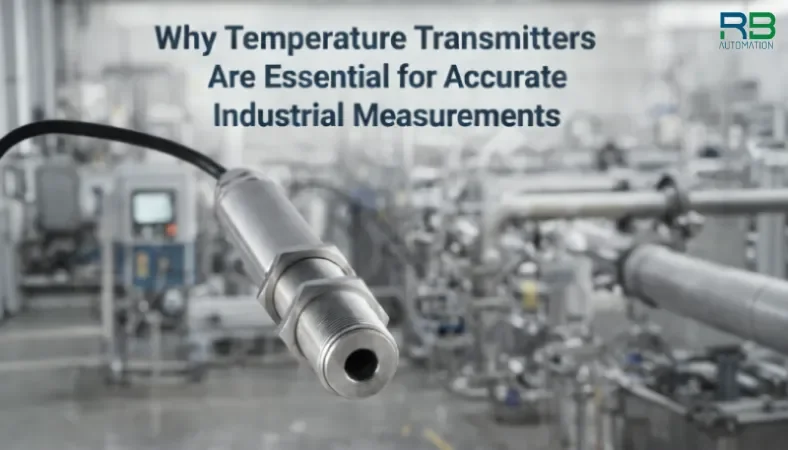
Why Temperature Transmitters Are Essential for Accurate Industrial Measurements
Key Takeaways
- Temperature transmitters convert weak sensor signals into stable, usable data for control systems, improving reliability in industrial operations.
- Accuracy in temperature measurement is critical because even small variations can impact product quality, safety, and equipment performance.
- They improve signal stability and reduce interference, making them essential in noisy industrial environments.
- Temperature transmitters enable seamless integration with automation systems like PLC, DCS, and SCADA for real-time monitoring and control.
- They are widely used across industries such as chemical, food, pharmaceutical, and power plants to maintain safety, efficiency, and compliance.
In modern industrial environments, precision is not just a requirement, it is the backbone of safety, efficiency, and productivity. From chemical processing plants to food manufacturing units, accurate temperature monitoring directly impacts product quality and operational reliability. This is where a Temperature Transmitter becomes a critical component. It bridges the gap between raw temperature sensing and actionable data, enabling industries to maintain control over complex processes.
A Temperature Transmitter converts the signal from temperature sensors such as RTDs or thermocouples into a standardized output signal that control systems can interpret. Without this conversion, raw data may be inconsistent, noisy, or difficult to integrate into automated systems. As industries move toward smarter and more automated operations, the role of reliable measurement devices becomes even more important.
Understanding Temperature Transmitters in Industrial Systems
A temperature transmitter acts as a bridge between the sensing element and the control system – a necessary intermediary that lets the signals from temperature sensors get to the people who need them. The catch is that sensors pick up temperature variations but the signals they put out are weak, and a bit too susceptible to interference. A Temperature Transmitter does just what it says on the tin: it amplifies the signal, and converts it into something more robust, like a 4-20 mA output, or sometimes a digital format like HART or Modbus.
This bit of signal conversion is crucial when it comes to stopping it from getting lost or ruined over long distances. The thing is, in large industrial plants, sensors are often stuck way out in the middle of nowhere, and the control room is some way off. The signal accuracy would simply plummet in the absence of a transmitter, and inaccurate readings would result in poor decision-making.
Why Accuracy Matters in Industrial Measurements
Temperature fluctuations can have some pretty serious consequences – like affecting product quality, or energy consumption, or even how long equipment lasts. You'd be surprised just how much of a difference even a tiny bit of deviation can make. In industries like food processing, product spoilage is a real risk if the temperature is off by even a smidgen, and in the chemical industry – well, any sort of reaction could go badly wrong if things are not just so. A Temperature Transmitter helps keep things consistent, which lets operators take timely action and prevent things from going wrong in the first place.
Being able to rely on accurate measurements is also useful when it comes to sticking to the rules. In lots of industries, there are strict quality and safety standards that must be met. With a reliable signal from a Temperature Transmitter, you can prove to auditors that you're doing everything with the book.
Key Benefits of Using Temperature Transmitters
Improved Signal Stability
Industrial places are always full of electrical noise and interference, so a Temperature Transmitter helps keep the signal stable – not letting external disturbances get in the way and mess up the reading.
Enhanced Measurement Accuracy
By taking a weak sensor signal and turning it into something a bit more standardized, a transmitter helps cut down on errors caused by signal loss. This ends up giving you more precise monitoring, and better control over your processes.
Better Integration with Automation Systems
Most modern control systems work with standardized signals for seamless operation, so a Temperature Transmitter makes it easy to integrate with things like PLCs, DCS, and SCADA systems – letting you keep an eye on things in real-time and take action if needed.
Reduced Maintenance Costs
Getting accurate readings early on means you can spot any issues before they become a problem, which in turn means less lost time when things do go wrong.
Applications Across Industries
Temperature transmitters are widely used across various sectors due to their versatility and reliability.
Chemical and Petrochemical Industry
In chemical processing, keeping a tight lid on temperature is vital for safe reactions – so a Temperature Transmitter gives you the real-time data you need to keep everything running smoothly and safely.
Food and Beverage Industry
Keeping the temperature right is a must for product safety and quality – so transmitters help you monitor storage, cooking and packaging processes to reduce the risk of contamination.
Pharmaceutical Industry
In the pharma world, strict temperature control is a must for drug manufacturing – so a Temperature Transmitter helps keep you compliant with rules and regulations and keeps product integrity intact.
Power Plants
Monitoring temperature is super important for turbines, boilers and generators – so accurate data helps you get the most out of your equipment and spots overheating before it becomes a problem.
Choosing the Right Temperature Transmitter
Selecting the right transmitter involves several factors:
- Type of sensor (RTD or thermocouple)
- Required accuracy level
- Environmental conditions
- Output signal requirements
- Installation location
Reliable Temperature Transmitter Suppliers in india provide a wide range of options tailored to specific industrial needs. Choosing a trusted supplier helps in achieving long-term performance and reliability.
Role of Technology in Modern Temperature Transmitters
Advancements in technology have transformed traditional transmitters into smart devices. Modern transmitters offer features such as:
- Digital communication protocols
- Remote calibration and diagnostics
- Enhanced accuracy with microprocessor-based designs
- Integration with IoT systems
These innovations make a Temperature Transmitter more than just a measurement device—it becomes a part of a connected industrial ecosystem.
Installation and Maintenance Considerations
Proper installation plays a significant role in achieving accurate measurements. Key considerations include:
- Correct placement of sensors
- Protection from environmental factors
- Proper wiring and grounding
Regular maintenance and calibration help maintain accuracy over time. A well-maintained Temperature Transmitter continues to deliver reliable data, supporting smooth industrial operations.
Why Choose Us
RBA OPTISYNC PRIVATE LIMITED stands out as a reliable partner for advanced industrial measurement solutions. With a strong focus on quality, innovation, and customer satisfaction, RBA OPTISYNC PRIVATE LIMITED delivers high-performance temperature transmitters designed to meet diverse industrial requirements. The company combines technical expertise with a deep understanding of industry challenges, offering solutions that align with modern automation needs. RBA OPTISYNC PRIVATE LIMITED prioritizes precision, durability, and long-term performance, making it a preferred choice among businesses seeking dependable Temperature Transmitter Suppliers in India. Their commitment to excellence and continuous improvement supports industries in achieving accurate and efficient operations.
Conclusion
Temperature measurement plays a central role in industrial efficiency, safety, and product quality. A reliable Temperature Transmitter transforms raw sensor data into accurate and actionable information, supporting better control and decision-making. From improving process efficiency to reducing maintenance costs, its benefits extend across multiple industries. As technology continues to evolve, the importance of advanced transmitters grows even further. Partnering with trusted Temperature Transmitter Suppliers in India allows businesses to access high-quality solutions tailored to their needs. RBA OPTISYNC PRIVATE LIMITED continues to contribute to industrial success by delivering reliable and efficient temperature measurement systems..
Looking for reliable solutions for accurate industrial temperature measurement? Contact RBA OPTISYNC PRIVATE LIMITED today at +918511104864 or email contact@rbautomate.com
Frequently Asked Questions
What is a temperature transmitter?
A Temperature Transmitter is a device that converts temperature sensor signals into standardized outputs for accurate monitoring and control.
Why is a temperature transmitter important in industries?
It provides accurate data, improves process control, and helps maintain safety and product quality.
Where are temperature transmitters commonly used?
They are used in industries like chemical processing, food production, pharmaceuticals, and power generation.
How do I choose the right temperature transmitter?
Consider sensor type, accuracy requirements, environmental conditions, and compatibility with control systems.
Why choose reliable Temperature Transmitter Suppliers in India?
Trusted Temperature Transmitter Suppliers in India offer high-quality products, technical support, and solutions tailored to industrial needs.

Mr. Gaurav Patel
Managing Director, RBA Optisync Private Limited, Ahmedabad
A visionary industrial leader, Gaurav Patel has steered RBA Optisync since 2013 as a trusted manufacturer, trader, and importer of premium automation and sensing solutions. Under his leadership, the company has built a strong reputation for delivering precision-engineered flow meters, pressure transmitters, proximity sensors, stepper motors, and AC drives across electrical and engineering industries nationwide. His commitment to quality, ethical business practices, and client-centric approach has earned RBA Optisync a vast and loyal customer base.