
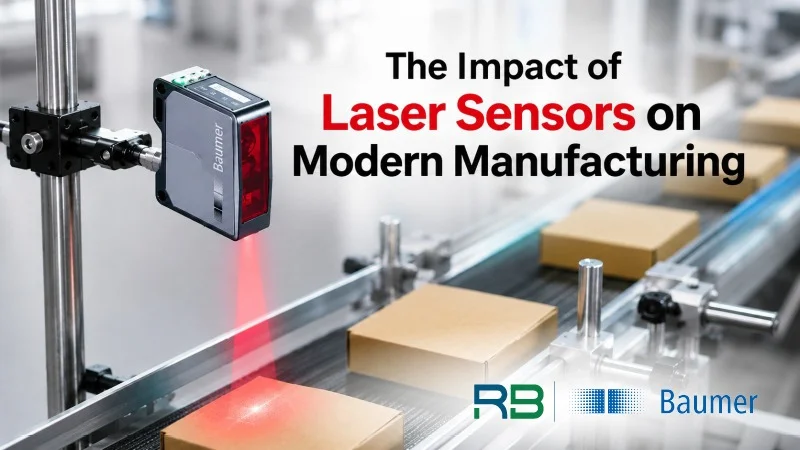
The Impact of Laser Sensors on Modern Manufacturing
Key Takeaways
- Laser sensors provide high measurement accuracy and fast response times, enhancing modern manufacturing productivity.
- As a leading Laser Distance Measurement Sensor Supplier in India, RBA OPTISYNC specializes in advanced sensor solutions.
- Non-contact operation of laser sensors prevents product damage, making them ideal for delicate and moving materials.
- Automated laser measurement systems help manufacturers maintain consistency and identify defects in real time, reducing waste.
- Choosing the right laser sensor involves considering measurement range, target material, and environmental conditions for optimal performance.
Modern manufacturing has evolved rapidly with the rise of automation, robotics, and digital production systems. Industries today focus on achieving higher productivity, greater accuracy, and consistent product quality while reducing manual intervention. Among the technologies driving this transformation, laser sensors have become one of the most valuable tools for industrial applications.
From automotive production lines to electronics manufacturing, packaging, pharmaceuticals, food processing, and metal fabrication, laser sensors provide fast and highly accurate measurements without making physical contact with the object. Their ability to detect position, distance, height, thickness, and object presence makes them an important component of modern industrial automation.
As a trusted industrial automation company, RBA OPTISYNC PRIVATE Limited provides advanced laser sensor solutions designed to meet the growing demands of smart manufacturing. Businesses searching for a reliable Laser Distance Measurement Sensor Supplier in India often look for products that combine precision, durability, and seamless integration into automated systems.
What Are Laser Sensors?
Laser sensors are electronic devices that use a focused laser beam to measure distance, detect objects, identify positions, or inspect product dimensions with exceptional accuracy. Unlike conventional mechanical measuring methods, laser sensors perform measurements without physical contact, making them suitable for fragile, hot, moving, or difficult-to-access objects.
A laser beam is directed toward a target by these sensors. The sensor uses the reflected light to compute a number of parameters once the beam has reflected back. This process allows industries to capture precise measurements in real time while production continues without interruption.
Laser sensors are widely adopted because they deliver:
- High measurement accuracy
- Fast response times
- Stable performance
- Long operational life
- Reliable data collection
- Non-contact inspection
- Easy integration into automated production systems
As manufacturing standards continue to rise, companies increasingly depend on experienced providers like RBA OPTISYNC PRIVATE Limited for industrial automation technologies that improve operational performance.
Why Modern Manufacturing Depends on Laser Sensors
Manufacturing has shifted from manual inspection toward intelligent automation. Every production line aims to produce thousands of identical products with minimal variation. Even a small dimensional error can result in rejected products, increased waste, customer complaints, and additional production costs.
Laser sensors help manufacturers maintain consistency throughout the manufacturing process.
Instead of relying solely on manual inspection, automated laser measurement systems continuously monitor production parameters and instantly detect deviations. This enables corrective action before defects spread across an entire production batch.
Solutions that support continuous production while retaining high measurement accuracy are preferred by companies searching for a trustworthy Laser Distance Measurement Sensor Supplier in India.
Key Features of Industrial Laser Sensors
Modern laser sensors include advanced technologies that make them suitable for demanding industrial environments.
High Precision Measurement
Laser sensors measure extremely small distances with remarkable accuracy. This level of precision supports industries where even tiny dimensional variations affect product quality.
Applications include:
- Precision engineering
- Automotive components
- Electronic assemblies
- Medical devices
- Metal fabrication
- Plastic molding
Non-Contact Operation
One of the biggest advantages of laser sensors is their ability to perform measurements without touching the object.
This provides several benefits:
- No mechanical wear
- No product damage
- Suitable for delicate materials
- Ideal for moving products
- Safe measurement of hot surfaces
Non-contact measurement also improves production speed because there is no need to stop machinery during inspection.
High-Speed Performance
Modern production lines operate at extremely high speeds.
Laser sensors capture measurements within milliseconds, making them suitable for:
- Conveyor systems
- Packaging lines
- Robotic automation
- High-speed assembly
- Continuous manufacturing
Fast measurement enables industries to inspect every product rather than relying on random sampling.
Reliable Operation in Challenging Conditions
Industrial environments often involve:
- Dust
- Vibrations
- Heat
- Moisture
- Continuous machine operation
Industrial-grade laser sensors are designed to perform consistently under these demanding conditions while maintaining stable measurement accuracy.
Major Applications of Laser Sensors in Manufacturing
Laser sensing technology has become a standard solution across multiple industries because of its flexibility and precision.
1. Automated Quality Inspection
Quality inspection is one of the most common applications.
Laser sensors monitor:
- Product dimensions
- Height variations
- Surface profiles
- Edge positions
- Assembly accuracy
Instead of waiting until final inspection, manufacturers identify production issues immediately, reducing waste and improving product consistency.
2. Robotic Guidance Systems
Industrial robots depend on accurate positioning information.
Laser sensors help robots:
- Locate components
- Identify workpiece positions
- Align products
- Improve pick-and-place accuracy
- Support automated assembly
This improves repeatability while reducing positioning errors.
3. Conveyor Automation
Conveyor systems move thousands of products every day.
Laser sensors assist by detecting:
- Product presence
- Product spacing
- Object height
- Material positioning
- Package alignment
Accurate sensing allows automated sorting, packaging, labeling, and inspection systems to operate smoothly.
4. Distance Measurement
Many industrial operations require continuous distance monitoring.
Laser distance sensors provide accurate measurements for:
- Machine positioning
- Crane movement
- Material handling
- Warehouse automation
- Lift positioning
- Industrial equipment monitoring
Businesses searching for a dependable Laser Distance Measurement Sensor Supplier in India often prioritize products capable of delivering consistent performance across demanding industrial applications.
5. Packaging Industry
Packaging automation requires precise positioning throughout the production process.
Laser sensors help verify:
- Package dimensions
- Label placement
- Carton positioning
- Bottle alignment
- Filling line movement
- Conveyor synchronization
These capabilities support higher productivity while reducing packaging errors.
6. Automotive Manufacturing
Automotive production demands exceptional dimensional accuracy.
Laser sensors are used for:
- Component positioning
- Body alignment
- Weld inspection
- Robot guidance
- Assembly verification
- Gap measurement
Their precision contributes to consistent production quality across large manufacturing volumes.
7. Metal Processing and Fabrication
Metal manufacturing requires precise measurement throughout cutting, welding, bending, and assembly operations. Even minor dimensional deviations can affect the performance and fit of finished products. Laser sensors provide continuous monitoring that helps manufacturers maintain tight production tolerances.
Common applications include:
- Sheet metal positioning
- Plate thickness measurement
- Steel profile inspection
- Weld seam alignment
- Pipe positioning
- CNC machine automation
By using laser sensors during production, manufacturers can improve dimensional consistency while reducing material waste and minimizing production interruptions.
8. Electronics Manufacturing
The electronics industry produces components with extremely small dimensions where precision is critical. Manual inspection is often insufficient for high-volume production, making laser sensors an effective solution for automated measurement and quality control.
Laser sensors support:
- PCB positioning
- Component alignment
- Connector inspection
- Assembly verification
- Automated handling
- Precision robotic movement
As electronic devices continue to become smaller and more complex, advanced laser sensing technology plays an increasingly important role in maintaining manufacturing accuracy.
Advantages of Laser Sensors in Industrial Automation
Industrial automation aims to improve productivity while maintaining consistent quality. Laser sensors contribute significantly by delivering reliable measurement data throughout the production process.
Improved Accuracy
Accurate measurements reduce dimensional variations and improve product consistency. Manufacturers can maintain strict quality standards while minimizing the risk of defective products reaching customers.
Higher Production Speed
Traditional inspection methods often require manual intervention, slowing down production. Laser sensors perform measurements instantly, allowing inspection to occur while products continue moving through the production line.
This supports:
- Continuous manufacturing
- Faster production cycles
- Increased operational efficiency
- Reduced inspection delays
Reduced Human Error
Manual measurement depends on operator skill and consistency. Automated laser sensors produce repeatable measurement results regardless of production volume or operating conditions.
This creates:
- Consistent inspection
- Standardized quality control
- Better process reliability
- Improved production confidence
Lower Material Waste
Early detection of dimensional variations allows manufacturers to correct production issues before they generate large quantities of rejected products.
Benefits include:
- Reduced scrap
- Better material utilization
- Lower production costs
- Improved operational efficiency
Enhanced Worker Safety
Certain manufacturing environments involve high temperatures, moving machinery, or hazardous operating conditions.
Laser sensors perform measurements remotely, allowing operators to monitor processes without direct exposure to dangerous equipment.
This contributes to safer industrial operations while supporting uninterrupted production.
Choosing the Right Laser Sensor
Selecting an appropriate laser sensor depends on the specific requirements of each application. Factors such as measuring range, object material, environmental conditions, and installation space should all be considered before implementation.
Important considerations include:
- Measurement Range: Choose a sensor capable of accurately measuring the required working distance without compromising precision.
- Target Material: Different materials reflect laser light differently. Sensor selection should account for surface color, texture, transparency, and reflectivity.
- Environmental Conditions: Industrial environments may involve dust, vibration, moisture, or temperature fluctuations. Selecting a sensor designed for these conditions supports reliable long-term performance.
- Response Speed: Applications involving high-speed production require sensors with rapid response times to capture accurate measurements without interrupting workflow.
- Integration Capability: Modern laser sensors should integrate easily with PLCs, industrial controllers, robotic systems, and automation software for smooth operation within existing production lines.
Future Trends in Laser Sensor Technology
Manufacturing technology continues to advance, and laser sensors are evolving alongside it. Future developments are expected to provide even greater precision, faster data processing, and enhanced compatibility with intelligent automation systems.
Emerging trends include:
- AI-assisted measurement systems
- Advanced predictive maintenance
- Compact sensor designs
- Increased measurement resolution
- Enhanced industrial networking
- Cloud-connected monitoring
- Real-time production analytics
- Greater integration with autonomous robotics
These advancements will support manufacturers in achieving higher productivity, improved quality, and more efficient production management.
The Growing Importance of Reliable Laser Sensor Solutions
As manufacturing becomes more competitive, companies are investing in technologies that improve efficiency without compromising quality. Laser sensors help industries maintain precise measurements, automate inspections, and support continuous production across a wide range of applications.
Organizations seeking dependable automation technology often value experienced providers with strong technical knowledge and industry-focused solutions.
Why Choose Us
When selecting a laser sensor partner, expertise, product quality, and technical support make a significant difference. RBA OPTISYNC PRIVATE Limited provides advanced industrial automation solutions designed to meet the changing demands of modern manufacturing. With a strong focus on innovation, precision, and reliable performance, the company provides laser sensor technologies suitable for a wide range of industrial applications. As a trusted Laser Distance Measurement Sensor Supplier in India, RBA OPTISYNC PRIVATE Limited works closely with customers to understand their operational needs and recommend solutions that integrate smoothly into existing automation systems. The commitment to quality products, dependable support, and industry-focused expertise makes the company a preferred choice for businesses seeking long-term automation solutions.
Conclusion
Modern manufacturing continues to evolve with greater emphasis on precision, automation, productivity, and consistent quality. Laser sensors have become an essential technology for industries that require fast, reliable, and non-contact measurement across diverse production environments. From robotic automation and quality inspection to packaging, metal processing, and electronics manufacturing, these sensors help streamline operations and improve overall efficiency. Choosing the right solution from an experienced technology provider can support long-term operational performance and smarter production processes.RBA OPTISYNC PRIVATE Limiteddelivers advanced laser sensor solutions designed to meet modern industrial requirements while helping businesses embrace the future of intelligent manufacturing with confidence.
Looking for the right laser sensor solution for your manufacturing application? Contact RBA OPTISYNC PRIVATE Limited today at +91 8511104864 or email contact@rbautomate.com.
Frequently Asked Questions
What types of applications benefit from laser sensors in manufacturing?
Laser sensors are widely used in various applications including automated quality inspection, robotic guidance systems, conveyor automation, distance measurement, and packaging processes. Their ability to provide precise, non-contact measurements makes them ideal for industries such as automotive, electronics, and metal fabrication.
Why should I choose RBA OPTISYNC as my Laser Distance Measurement Sensor Supplier in India?
RBA OPTISYNC PRIVATE Limited offers advanced industrial automation solutions, including reliable laser sensors designed for precision and durability. Their commitment to quality, technical expertise, and customer support make them a trusted partner for manufacturers seeking effective automation solutions.
How do laser sensors improve production efficiency?
Laser sensors enhance production efficiency by providing fast, accurate measurements without requiring manual intervention. This supports continuous manufacturing, reduces inspection delays, and minimizes material waste by allowing early detection of dimensional variations.
What are the key features of modern laser sensors used in industrial automation?
Modern laser sensors are characterized by high precision measurement, non-contact operation, and high-speed performance. They are also designed to operate reliably in challenging industrial conditions, making them suitable for various applications across manufacturing sectors.
Can laser sensors be integrated into existing automation systems?
Yes, laser sensors are designed for easy integration with PLCs, industrial controllers, and automation software. This compatibility allows for seamless operation within existing production lines, improving overall efficiency without major installations.

Mr. Gaurav Patel
Managing Director, RBA Optisync Private Limited, Ahmedabad
A visionary industrial leader, Gaurav Patel has steered RBA Optisync since 2013 as a trusted manufacturer, trader, and importer of premium automation and sensing solutions. Under his leadership, the company has built a strong reputation for delivering precision-engineered flow meters, pressure transmitters, proximity sensors, stepper motors, and AC drives across electrical and engineering industries nationwide. His commitment to quality, ethical business practices, and client-centric approach has earned RBA Optisync a vast and loyal customer base.