

Smart Inverter Selection Checklist: Motor Power, Voltage, Phase & Control Mode Explained
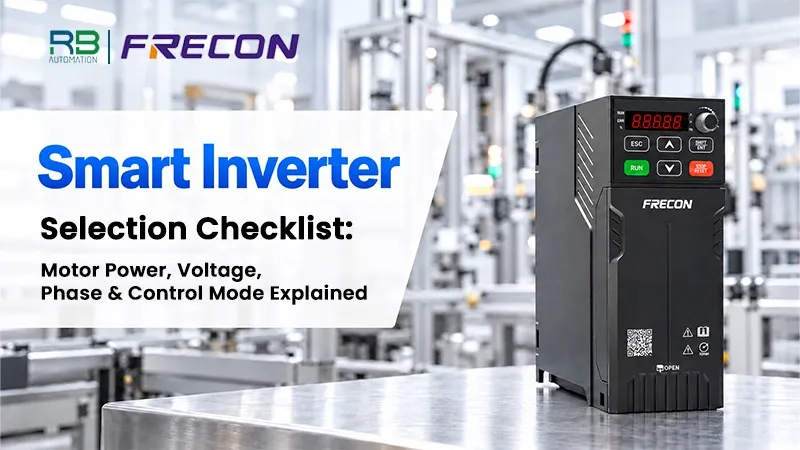
Key Takeaways
- Understand the motor power rating is critical for selecting the right inverter configuration.
- As a Frecon Smart Inverter supplier in India, we emphasize the importance of matching input voltage and phase carefully.
- Selecting the right control mode affects motor performance significantly; consider your specific application requirements.
- Confirming starting torque and load characteristics is essential for effective inverter selection and performance.
- Evaluate installation space and environmental conditions to ensure optimal inverter functionality in your application.
RBA OPTISYNC PRIVATE LIMITED is a leading provider of smart inverter and industrial automation solutions.
Choosing an inverter only by its motor kW rating can lead to the wrong configuration for the machine. Motor power, supply voltage, input phase, operating load and control method all need to be considered together.
As a Frecon Smart Inverter supplier in India, we help B2B buyers evaluate these factors before selecting an inverter for their application. Buyers searching for a dependable smart inverter supplier in India should start with the actual electrical and mechanical requirements of the motor.
1. Start With the Motor Power Rating
Motor power is the first specification to check because the inverter must be selected for the motor it will control. Before selecting a suitable model, check the motor nameplate to confirm the rated power, voltage, current, frequency, and required operating conditions.
The Frecon FR01 range includes single-phase 220V versions with adapted motor ratings from 0.4 kW to 4.0 kW. Its three-phase 380V range includes models with adapted motor ratings up to 7.5 kW.
Before selection, verify:
- Motor rated power in kW or HP
- Motor rated current
- Normal operating load
- Starting load requirement
- Acceleration and deceleration needs
The inverter should be selected based on the motor’s operating requirements and the specific application, rather than relying solely on the motor’s power rating.
2. Match the Input Voltage Correctly
Input voltage is a fundamental selection point. Using an inverter designed for a different voltage class from the available electrical supply can make the proposed configuration unsuitable.
The Frecon FR01 model coding identifies 220V and 380V voltage classes. According to the product specifications, the 220V version is intended for single-phase input, while the 380V range uses three-phase input.
At RBA OPTISYNC PRIVATE LIMITED, our team recommends confirming the site's available supply voltage before finalising the inverter model. This small check can prevent specification changes later during panel design or machine commissioning.
3. Determine Whether the Electrical Supply Is Single-Phase or Three-Phase
Voltage and phase must be checked together. A 220V supply does not automatically mean the same inverter model can be used on every installation, and the machine's available electrical infrastructure should be reviewed first.
For the FR01 series, buyers can consider the following product configuration:
| Selection Factor | FR01 220V Range | FR01 380V Range |
|---|---|---|
| Input phase | Single phase | Three phase |
| Nominal voltage class | 220V | 380V |
| Listed motor range | 0.4–4.0 kW | Up to 7.5 kW |
| Input frequency | 50/60 Hz | 50/60 Hz |
These published specifications make phase and voltage identification an important early step when discussing requirements with a Frecon Smart Inverter supplier in India.
4. Select the Control Mode According to the Application
Control mode affects how the inverter manages motor speed and torque. Not all machines require the same degree of motor control.
The Frecon FR01 supports V/F control and two sensorless vector control modes. Its published output frequency range is 0 to 600 Hz.
V/F control can suit applications where straightforward variable-speed operation is required. Sensorless vector control is relevant when the application demands more capable speed and torque behaviour without adding an external motor encoder.
When working with a smart inverter supplier in India, describe how the machine starts, accelerates, runs under load and changes speed. This gives the supplier far more useful information than simply providing the motor kW rating.
5. Review Starting Torque and Load Characteristics
Two motors with the same power rating may perform very different jobs. A lightly loaded fan and a machine that starts under mechanical load should not automatically be treated as identical inverter applications.
The FR01 specification lists 150% starting torque at 0.5 Hz for V/F control for sensorless vector control 1, and 150% at 0.25 Hz for sensorless vector control 2. It also publishes defined overload capabilities for short-duration demand.
Load behaviour is therefore a key part of inverter selection, not an afterthought.
6. Check How the Inverter Will Receive Commands
Before buying, decide how operators or the control system will command the motor. The application may require local keypad control, external terminals or communication from another controller.
The FR01 supports command input from the control panel, control terminals and serial communication. It also provides multiple frequency-source options.
As a Frecon Smart Inverter supplier in India, we recommend defining the machine control architecture before model finalisation, particularly when the inverter will form part of a larger automated system.
7. Consider Installation and Panel Space
Modern machine panels often have limited usable space. Inverter dimensions and mounting arrangements therefore deserve attention during selection, especially when several drives are installed inside one panel.
The FR01 uses a narrow book-type body and supports standard rail installation. The product information also specifies side-by-side installation at zero distance, designed to improve panel-space utilisation. A detachable keypad supports different installation scenarios.
These practical factors can be valuable for machine builders looking for compact control-panel layouts.
8. Review the Operating Environment
Electrical specifications are just one of several factors to consider when making a selection. Ambient temperature, dust, moisture, altitude, ventilation and surrounding conditions can influence how an inverter should be installed and operated.
The FR01 specifications list IP20 protection, forced-air cooling and an operating ambient temperature range of -10°C to 40°C, with derating stated above 40°C. The product information also specifies altitude-related derating above 1,000 metres(De-rate 1% for Every 100m when the altitude is above 1000 meters).
A knowledgeable smart inverter supplier in India should ask about the installation environment rather than treating every factory application as identical.
9. Check Braking Requirements
Certain machines require quick braking, repeated stopping, and accurate control of operating speed. These operating conditions should be identified before selecting the final inverter configuration.
The FR01 model description identifies variants with a built-in brake unit using the model-code designation “B.”
Our team at RBA OPTISYNC PRIVATE LIMITED recommends sharing acceleration, deceleration, stopping behaviour and duty requirements when requesting a model recommendation. This makes it easier to evaluate whether the selected configuration matches the intended machine operation.
10. Select a Supplier That Understands the Application
Inverter selection should combine motor data with machine behaviour. A supplier should understand the motor rating, voltage, phase, load, control mode and operating conditions before recommending a model.
When choosing a Frecon Smart Inverter supplier in India, B2B buyers should provide the motor nameplate details along with information about the machine and expected duty. Working with an experienced smart inverter supplier in India also gives buyers a practical route for discussing model selection, panel integration and technical requirements before purchase.
Why Choose Us
At RBA OPTISYNC PRIVATE LIMITED, we work with industrial buyers, OEMs and machine builders who need application-focused automation products and technical support. Our approach to smart inverter selection starts with understanding the motor, electrical supply and machine requirement rather than recommending a model based on one specification. We supply Frecon automation products across India and help customers evaluate the appropriate FR01 configuration for their motor-control application.
Conclusion
Selecting a smart inverter becomes much clearer when the decision is broken into the right technical checks. Start with motor power and rated current, then confirm voltage and phase before evaluating control mode, load behaviour, command method, installation space, operating environment and braking needs.
The Frecon FR01 series provides multiple motor ratings, V/F and sensorless vector control options, and compact installation features for different machine requirements. At RBA OPTISYNC PRIVATE LIMITED, we help B2B buyers review these details so the selected inverter is aligned with the actual motor and machine application.
Planning to purchase a Frecon FR01 Smart Inverter for your machine or industrial automation project? Share your motor power, voltage, phase and application details with our sales team for product selection assistance and a suitable model recommendation.
Call: +91 8511104864
Email: contact@rbautomate.com
Frequently Asked Questions
What factors should I consider when selecting a smart inverter?
You should evaluate motor power rating, input voltage, input phase, control mode, starting torque, and load characteristics. Each of these factors plays a vital role in ensuring that the inverter meets the operational requirements of your machine.
Why is it important to match the input voltage correctly when choosing a smart inverter?
Matching the input voltage is crucial because using an inverter designed for a different voltage class can result in an unsuitable configuration. Always confirm the available electrical supply before finalizing the inverter model to prevent complications later.
How does control mode affect smart inverter performance?
Control mode determines how the inverter manages motor speed and torque. Selecting the appropriate control mode according to your application needs can optimize performance and efficiency.
What is the significance of knowing the electrical supply phase when selecting a smart inverter?
Understanding whether you are working with a single-phase or three-phase supply helps in identifying compatible inverter models. This step is essential for ensuring that the selected inverter operates correctly within the existing electrical infrastructure.
How can I find a reliable Frecon smart inverter supplier in India?
To find a dependable Frecon smart inverter supplier in India, look for suppliers who understand the unique requirements of your application and can provide technical support. RBA OPTISYNC PRIVATE LIMITED specializes in helping B2B buyers evaluate motor specifications and suggest suitable inverter configurations.

Mr. Gaurav Patel
Managing Director, RB Automation, Ahmedabad
A visionary industrial leader, Gaurav Patel has steered RB Automation since 2013 as a trusted manufacturer, trader, and importer of premium automation and sensing solutions. Under his leadership, the company has built a strong reputation for delivering precision-engineered flow meters, pressure transmitters, proximity sensors, stepper motors, and AC drives across electrical and engineering industries nationwide. His commitment to quality, ethical business practices, and client-centric approach has earned RB Automation a vast and loyal customer base.