
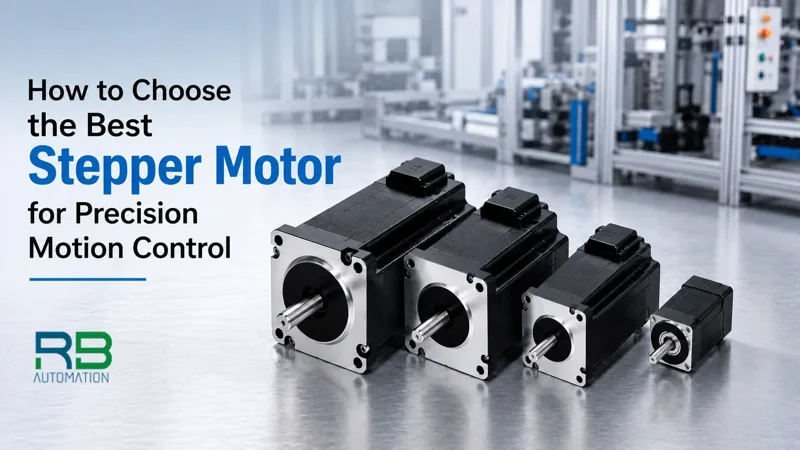
How to Choose the Best Stepper Motor for Precision Motion Control
Key Takeaways
- Choosing the right stepper motor impacts accuracy and productivity in automation applications.
- Evaluate torque requirements to prevent issues such as missed steps and overheating.
- Select a reliable Nema 17 Stepper Motor Supplier in India for compact applications needing precision.
- Ensure driver compatibility to maximize stepper motor performance and improve operational life.
- Understanding load characteristics is crucial for selecting the appropriate stepper motor for your needs.
Precision motion control has become one of the most important aspects of modern industrial automation. Whether it is a CNC machine, 3D printer, packaging system, laboratory equipment, robotics application, textile machinery, semiconductor equipment, or medical device, selecting the right stepper motor directly affects machine accuracy, productivity, and operational stability.
Unlike conventional motors that rotate continuously, stepper motors move in precise incremental steps. This unique operating principle allows machines to perform highly accurate positioning without requiring complex feedback systems in many applications. As industries continue adopting automation technologies, the demand for reliable and high-performance stepper motors continues to grow.
However, selecting the ideal stepper motor is not as simple as choosing a motor with the highest torque. Factors such as load requirements, operating speed, frame size, voltage, current rating, driver compatibility, environmental conditions, and application-specific requirements all influence overall performance.
Businesses searching for a reliable Nema 17 Stepper Motor Supplier in India, Nema 23 Stepper Motor Supplier in India, or Nema 34 Stepper Motor Supplier in India should understand these technical considerations before making a purchase decision. RBA OPTISYNC PRIVATE Limited provides a wide range of industrial automation solutions designed to support diverse precision motion control applications across multiple industries.
What Is a Stepper Motor?
A stepper motor is a brushless synchronous electric motor that divides a full rotation into multiple equal steps. Each electrical pulse received by the motor moves the shaft by a specific angle, allowing highly controlled positioning without continuous rotation.
Instead of relying solely on speed control, stepper motors provide precise position control, making them suitable for equipment that requires repeatable movement and accurate positioning.
Their ability to stop, hold, and move to predetermined positions makes them widely used across industrial automation.
Why Precision Motion Control Matters
Every automated machine depends on accurate positioning to produce consistent results.
Even a slight positioning error can lead to:
- Product defects
- Poor machining quality
- Material wastage
- Increased downtime
- Reduced production efficiency
- Higher maintenance costs
A properly selected stepper motor delivers consistent movement, smooth acceleration, reliable stopping accuracy, and repeatable positioning. This makes it one of the preferred motion control solutions across manufacturing industries.
Important Factors to Consider Before Choosing a Stepper Motor
Choosing the right motor requires evaluating several technical parameters rather than focusing on a single specification.
1. Required Torque
Torque is one of the first specifications engineers evaluate.
The motor should produce sufficient torque to move the intended load while maintaining stable positioning during operation.
Important torque considerations include:
- Starting torque
- Running torque
- Holding torque
- Peak load torque
- Acceleration torque
Underestimating torque requirements can result in:
- Missed steps
- Positioning errors
- Overheating
- Machine failure
Choosing a motor with excessive torque may unnecessarily increase system cost and power consumption.
2. Holding Torque
Holding torque refers to the motor's ability to maintain its position while stationary under load.
Applications requiring frequent stopping and positioning depend heavily on sufficient holding torque.
Examples include:
- Pick-and-place machines
- CNC machinery
- Vertical lifting systems
- Robotic arms
- Indexing tables
When evaluating industrial automation systems, holding torque often becomes one of the most important performance parameters.
3. Step Angle
The step angle determines how far the shaft rotates after receiving one electrical pulse.
Common step angles include:
- 1.8°
- 0.9°
- 7.5°
- 15°
A smaller step angle produces higher positioning resolution.
For example:
A 1.8° motor completes:
- 200 steps per revolution
A 0.9° motor completes:
- 400 steps per revolution
Applications demanding higher positioning precision often benefit from smaller step angles.
4. Motor Speed
Although stepper motors excel in positioning accuracy, their torque gradually decreases as speed increases.
Before selecting a motor, determine:
- Operating RPM
- Maximum RPM
- Acceleration profile
- Continuous operating speed
Matching the motor's speed characteristics with machine requirements helps maintain smooth operation throughout the working cycle.
5. Load Characteristics
Understanding the load is equally important.
Loads generally fall into three categories:
Constant Load
The motor experiences similar resistance throughout operation.
Examples include:
- Conveyor systems
- Indexing tables
Variable Load
Resistance changes depending on operating conditions.
Examples include:
- Packaging equipment
- Filling machines
Inertial Load
Heavy rotating masses require additional acceleration torque.
Examples include:
- Flywheels
- Large rotating platforms
- CNC spindles
Selecting the correct motor depends on accurately calculating these load conditions.
6. Frame Size
Stepper motors are available in standardized frame sizes.
The most commonly used include:
NEMA 17
Suitable for:
- Desktop CNC machines
- Small robots
- Camera sliders
- Compact automation equipment
Many small automation manufacturers prefer working with an experienced Nema 17 Stepper Motor Supplier in India for applications where compact size and precision are priorities.
NEMA 23
Commonly used for:
- Industrial CNC routers
- Laser machines
- Medium-duty automation
- Packaging equipment
- Industrial robotics
Its balance of torque and size makes it one of the most versatile choices for industrial motion control.
NEMA 34
NEMA 34 stepper motors are designed for high-load industrial applications requiring superior torque and reliable performance.
Typical applications include:
- Heavy-duty CNC machines
- Industrial automation systems
- Material handling equipment
- Printing presses
- Textile machinery
- Large robotic systems
Industries searching for a dependable Nema 34 Stepper Motor Supplier in India often prioritize motors that offer high torque, long service life, and compatibility with industrial motion control systems.
7. Voltage and Current Ratings
Voltage and current ratings significantly affect a stepper motor's performance.
Higher voltage generally allows the motor to maintain torque at higher speeds, while current determines the motor's torque output. Matching the motor with a compatible driver is essential for stable operation.
Before selecting a motor, verify:
- Rated voltage
- Phase current
- Driver compatibility
- Power supply specifications
- Operating temperature range
Incorrect electrical matching may lead to overheating, reduced efficiency, or unstable operation.
8. Driver Compatibility
A stepper motor performs best when paired with a suitable driver.
Modern stepper drivers provide features such as:
- Micro stepping
- Smooth acceleration
- Current regulation
- Reduced vibration
- Lower noise levels
- Improved positioning accuracy
Selecting a compatible driver helps maximize the motor's performance while extending its operational life.
9. Microstepping for Higher Precision
Microstepping is an advanced driving technique that divides each full step into smaller increments.
Benefits include:
- Smoother motion
- Better positioning resolution
- Reduced vibration
- Lower operating noise
- Improved low-speed performance
Although microstepping improves motion quality, it should be combined with proper mechanical design and accurate motor sizing for the best results.
10. Environmental Conditions
Industrial environments vary greatly, making operating conditions an important consideration.
Factors to evaluate include:
- Ambient temperature
- Humidity
- Dust exposure
- Chemical exposure
- Continuous duty cycles
- Ventilation
Selecting a motor suited to its operating environment contributes to long-term reliability and consistent performance.
Common Applications of Stepper Motors
Stepper motors support a wide variety of industries where accurate positioning and repeatable motion are essential.
CNC Machines
CNC routers, milling machines, engraving systems, and plasma cutters rely on stepper motors for precise axis movement.
Robotics
Robotic systems require accurate movement for assembly, welding, inspection, and pick-and-place operations.
3D Printing
Modern 3D printers depend on precise stepper motor movement to build detailed components layer by layer.
Packaging Industry
Packaging equipment uses stepper motors for filling, labeling, sealing, indexing, and product positioning.
Textile Machinery
Textile production machines use stepper motors for synchronized movement, fabric feeding, and automated positioning.
Medical Equipment
Diagnostic instruments and laboratory automation systems require repeatable motion, making stepper motors a preferred solution.
Electronics Manufacturing
PCB assembly, semiconductor production, and inspection systems rely on accurate motion control for consistent manufacturing quality.
Common Mistakes to Avoid When Selecting a Stepper Motor
Selecting the wrong motor can reduce efficiency and increase operating costs.
Avoid these common mistakes:
Ignoring Torque Calculations
Never estimate torque requirements without considering the actual load.
Choosing Only Based on Price
The least expensive motor may not deliver the reliability required for industrial automation.
Selecting an Oversized Motor
A motor that is significantly larger than required can increase system cost, power consumption, and installation space.
Ignoring Driver Compatibility
The driver and motor should always be selected together for optimal performance.
Overlooking Future Expansion
Consider future upgrades, higher loads, or increased production capacity before finalizing your motor selection.
Why Choose us
Choosing the right automation partner is just as important as selecting the right motion control component. RBA OPTISYNC PRIVATE Limited is committed to providing high-quality stepper motor solutions that meet the performance expectations of modern industries. With a strong focus on quality, technical expertise, and customer satisfaction, the company offers dependable products suitable for CNC machines, robotics, packaging systems, textile machinery, laboratory equipment, and industrial automation applications. Customers trust RBA OPTISYNC PRIVATE Limited for its extensive product knowledge, professional support, reliable delivery, and dedication to helping businesses select motion control solutions that align with their operational requirements. Whether you are searching for a Nema 17 Stepper Motor Supplier in India , Nema 23 Stepper Motor Supplier in India ,Nema 34 Stepper Motor Supplier in IndiaRBA OPTISYNC PRIVATE Limited provides solutions designed for consistent performance and long-term reliability.
Conclusion
Choosing the best stepper motor for precision motion control requires careful evaluation of torque, speed, frame size, holding torque, voltage, driver compatibility, load characteristics, and application requirements. A properly selected motor improves positioning accuracy, operational efficiency, and long-term machine performance while reducing maintenance and downtime. Whether your automation project involves CNC machinery, robotics, packaging equipment, medical devices, or industrial manufacturing, investing in the right motion control solution delivers lasting value. By partnering with RBA OPTISYNC PRIVATE Limited, businesses gain access to dependable stepper motor solutions supported by technical expertise, quality products, and reliable customer service for a wide range of industrial applications.
Looking for the ideal stepper motor for your precision motion control application? Contact RBA OPTISYNC PRIVATE Limited today for expert guidance and product information. Call +91 8511104864 or email contact@rbautomate.com
Frequently Asked Questions
What factors should I consider when choosing a Nema 17 Stepper Motor Supplier in India?
When selecting a Nema 17 Stepper Motor Supplier in India, consider factors such as torque requirements, holding torque, step angle, and driver compatibility. It's also important to assess the supplier's product quality, delivery reliability, and technical support.
How does holding torque affect the performance of a stepper motor?
Holding torque is crucial as it determines the motor's ability to maintain its position under load while stationary. A motor with insufficient holding torque can lead to positioning errors and reduced operational efficiency in applications requiring frequent stops.
What is the significance of step angle in stepper motors?
The step angle indicates how much the motor shaft rotates with each electrical pulse. Smaller step angles provide higher positioning resolution, making them ideal for applications that require precise movement.
Can you explain the importance of driver compatibility when selecting a Nema 23 Stepper Motor Supplier in India?
Driver compatibility is essential because it directly affects the motor's performance and efficiency. A suitable driver ensures smooth operation, reduces vibration, and maximizes torque at various speeds, enhancing overall motion control.
What are the common applications of Nema 34 stepper motors?
Nema 34 stepper motors are typically used in high-load applications like heavy-duty CNC machines, industrial automation systems, material handling equipment, and large robotic systems. Their superior torque and reliable performance make them suitable for demanding industrial environments.

Mr. Gaurav Patel
Managing Director, RBA Optisync Private Limited, Ahmedabad
A visionary industrial leader, Gaurav Patel has steered RBA Optisync since 2013 as a trusted manufacturer, trader, and importer of premium automation and sensing solutions. Under his leadership, the company has built a strong reputation for delivering precision-engineered flow meters, pressure transmitters, proximity sensors, stepper motors, and AC drives across electrical and engineering industries nationwide. His commitment to quality, ethical business practices, and client-centric approach has earned RBA Optisync a vast and loyal customer base.